TEMPLATE
STREAMLINE YOUR CONTINGENT WORKFORCE GOVERNANCE WITH CLEAR ROLE ACCOUNTABILITY
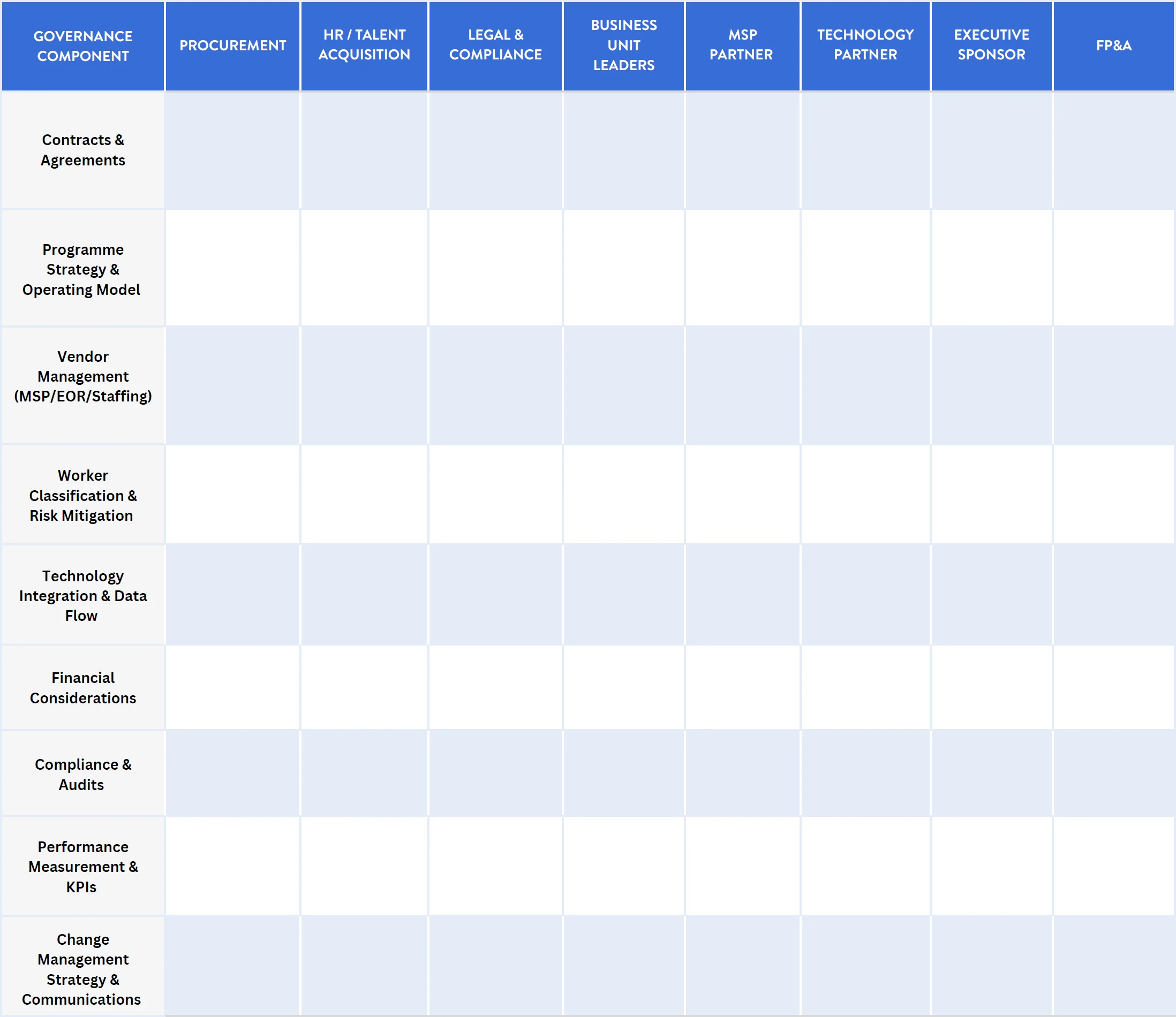
Atrium’s team of contingent workforce experts has created a governance role-mapping template to help you clearly define and align responsibilities across key functions, including Procurement, HR, Legal, Business Leaders, Partners, and Sponsors.
STREAMLINE YOUR CONTINGENT WORKFORCE GOVERNANCE WITH CLEAR ROLE ACCOUNTABILITY
Atrium’s team of contingent workforce experts developed this governance role-mapping template to help you define and align the responsibilities across essential functions, including Procurement, HR, Legal, Business Leaders, Partners, and Sponsors. By delineating ownership within both current and future operating models, you ensure that each role’s contribution to your overarching goals is understood and optimised.
THE POWER OF CLEAR RESPONSIBILITIES
Clarifying responsibilities enhances collaboration and helps identify redundancies, gaps, or overlaps in functions that may hinder programme performance. For example, understanding where Procurement and HR intersect can prevent misaligned hiring practices or procurement decisions that do not sufficiently consider workforce dynamics.
- Facilitating productive governance design conversations
- Building stakeholder buy-in through documented accountability
- Creating operational coherence across all functions
- Enabling nuanced, informed decision-making
- Delivering more effective programme outcomes

DESIGNING YOUR OWN CUSTOM RACI FRAMEWORK
The most effective contingent workforce programmes align seamlessly with your company’s unique structure, culture, and strategic priorities. Each department brings distinct perspectives, requirements, and success metrics that should be thoughtfully integrated into your governance model.
- Where does decision-making authority currently reside? Map existing approval workflows to avoid creating governance conflicts.
- What are each stakeholder’s primary concerns? HR focuses on compliance and employee experience, while procurement prioritises cost optimisation and vendor management.
- How do communication patterns flow in your organisation? Align your RACI with natural information channels to ensure adoption.
- What level of involvement works best for each group? Some stakeholders need deep engagement, while others require only informed status updates.
BUILDING STEERING COMMITTEES FOR STRATEGIC ALIGNMENT
Steering Committees serve as the central governance body. Executive sponsors, HR, Procurement, Legal, Compliance, and Technology leaders meet in these committees to prioritise programme initiatives and ensure decisions reflect multiple perspectives and align with organisational goals. Meetings are typically held quarterly.
- Quality Business Reviews: Review programme performance, labour market trends, cross-client results, SLA and KPI performance, and strategic initiatives
- Strategy Meetings: Review programme roadmaps and maintain alignment across functions
- Weekly and Monthly Programme Syncs: Track progress, coordinate projects, prepare for Steering Committee or QBR meetings, review operational performance, and support regional compliance

GOVERNANCE THAT WORKS
By thoughtfully role-mapping governance stakeholders and establishing the right committees, you create clarity around decision-making and accountability. Each role becomes aligned to shared objectives, allowing governance to function with greater focus and impact. If you’re looking to streamline your contingent workforce governance, Atrium’s experts are here to help with practical experience and a disciplined approach.